

When McDonald’s corporation shocked the fast food industry in late 2023 by launching CosMc’s, few could have predicted the seismic impact this CosMc’s vs McDonald’s comparison would have on the restaurant economy. Named after an obscure alien-themed McDonald’s mascot from the 1980s, CosMc’s represented more than just another franchise expansion—it was McDonald’s bold attempt to capture market share in the lucrative $45 billion specialty coffee and beverage industry dominated by Starbucks and Dunkin’ Donuts.
The story of CosMc’s vs McDonald’s is a masterclass in corporate strategy, market experimentation, and economic adaptation that every restaurant industry analyst and business strategist should understand. From its meteoric rise generating double the foot traffic of traditional McDonald’s locations to its strategic closure in June 2025, this CosMc’s vs McDonald’s case study has fundamentally altered how we think about fast food innovation, beverage market competition, and restaurant brand diversification in an increasingly challenging economic landscape.
CosMc’s vs McDonald’s: The Revolutionary Brand Strategy That Changed Fast Food
The launch of CosMc’s in late 2023 marked a pivotal moment in McDonald’s 70-year corporate history and represented the company’s most ambitious brand extension since the introduction of McCafé. But what drove McDonald’s executives to risk their $23 billion annual revenue model on an experimental alien-themed beverage concept that seemed so far removed from their core Big Mac and french fries identity? The CosMc’s vs McDonald’s strategy comparison reveals fascinating insights into modern restaurant innovation.
McDonald’s market research had identified a critical gap in their customer acquisition strategy. While traditional McDonald’s restaurants served approximately 70 million customers daily worldwide, the company was losing significant market share to specialty beverage chains among the coveted 18-34 demographic. Starbucks alone generated over $32 billion in annual revenue, with average transaction values nearly three times higher than McDonald’s due to premium beverage pricing and customization options. This CosMc’s vs McDonald’s revenue analysis highlighted the potential for expansion.
CosMc’s was conceived as what McDonald’s corporate leadership termed a “learning laboratory”—a controlled environment where the fast food giant could experiment with innovative flavors, advanced beverage technologies, and novel customer experience models without disrupting their core business operations that serve one in eight Americans daily. This strategic approach allowed McDonald’s to test the waters in the high-margin specialty beverage market while maintaining the operational stability of their 40,000 global locations.
The timing of CosMc’s launch coincided with significant shifts in consumer behavior patterns. Post-pandemic dining preferences had evolved toward personalized experiences, Instagram-worthy presentations, and premium beverage consumption. Market data showed that 73% of Gen Z consumers were willing to pay premium prices for customizable drinks, while social media influence on restaurant choices had increased by 34% since 2020. The CosMc’s vs McDonald’s target demographic analysis showed McDonald’s executives that traditional fast food marketing strategies were becoming less effective with younger consumers who prioritized experience over convenience.
The CosMc’s vs McDonald’s positioning strategy represented McDonald’s direct challenge to the specialty coffee market oligopoly. Unlike traditional McDonald’s locations that focus on speed and value, CosMc’s emphasized beverage craftsmanship, flavor innovation, and social media appeal. The small-format restaurants featured advanced beverage preparation equipment, customizable ordering systems, and interior designs specifically optimized for social media content creation—a stark departure from McDonald’s traditional red and yellow aesthetic. This CosMc’s vs McDonald’s differentiation strategy aimed to capture entirely new market segments.
CosMc’s vs McDonald’s Menu Innovation: Understanding the Market Positioning Battle
The CosMc’s vs McDonald’s menu comparison represented perhaps the most ambitious culinary departure in McDonald’s corporate history, featuring beverages with names that sounded more suitable for a science fiction movie than a drive-thru restaurant. The signature drink lineup included the Vanilla Matcha Galaxy Latte, French Toast Nebula Cold Brew, and Oat & Honey Moon Frappé—each designed to compete directly with Starbucks’ premium beverage offerings while incorporating McDonald’s operational efficiency.
Market analysis revealed that CosMc’s most popular beverages were the shaken espresso varieties, including Pistachio Swirl, Churro Blast, and Sea Salted Caramelactic—drinks that commanded average prices 40% higher than traditional McDonald’s beverage offerings. These premium drinks generated gross margins approaching 80%, compared to McDonald’s traditional food items that typically achieved 20-25% margins. The CosMc’s vs McDonald’s profitability analysis showed how beverage innovation could transform restaurant economics.
The flavored cold brew selections, featuring varieties like Blue Raspberry Burst and Tropical Fusion, attracted younger customers who shared their colorful drinks across social media platforms, generating organic marketing value estimated at $2.3 million in earned media during CosMc’s first six months. This CosMc’s vs McDonald’s social media impact demonstrated the power of Instagram-worthy beverage presentations in modern restaurant marketing.
The signature “Galactic Boosts” energy drink category represented CosMc’s most innovative offering, featuring caffeine-enhanced beverages like Sour Cherry Energy Explosion and Blueberry Ginger Boost that contained 150-200mg of caffeine—comparable to leading energy drink brands but positioned as craft beverages rather than functional drinks. These products targeted the $15 billion energy drink market dominated by Red Bull and Monster Energy, demonstrating McDonald’s intention to diversify beyond traditional fast food categories through the CosMc’s vs McDonald’s expansion strategy. CosMc’s food offerings, while secondary to beverages, included the wildly popular McPops—artisanal donut holes available in flavors like Cosmic Cinnamon, Galaxy Glazed, and Stellar Strawberry. These premium snacks, priced at $3.99 for a four-piece serving, generated higher per-unit profits than McDonald’s traditional dessert offerings. The breakfast sandwich selection featured elevated ingredients like artisanal cheeses, specialty breads, and premium proteins, positioning CosMc’s as a legitimate competitor to fast-casual breakfast chains like Panera Bread and Einstein Bros. Bagels.
The beverage customization system at CosMc’s allowed customers to modify drinks across multiple dimensions including flavor intensity, sweetness levels, milk alternatives, and add-in selections. This level of personalization, supported by advanced point-of-sale technology and specialized training programs, enabled CosMc’s to achieve average transaction values of $8.50 compared to McDonald’s traditional $4.20 average. The CosMc’s vs McDonald’s transaction value comparison revealed the premium positioning success. Market research indicated that 67% of CosMc’s customers utilized customization options, with 34% creating social media content featuring their personalized beverages.
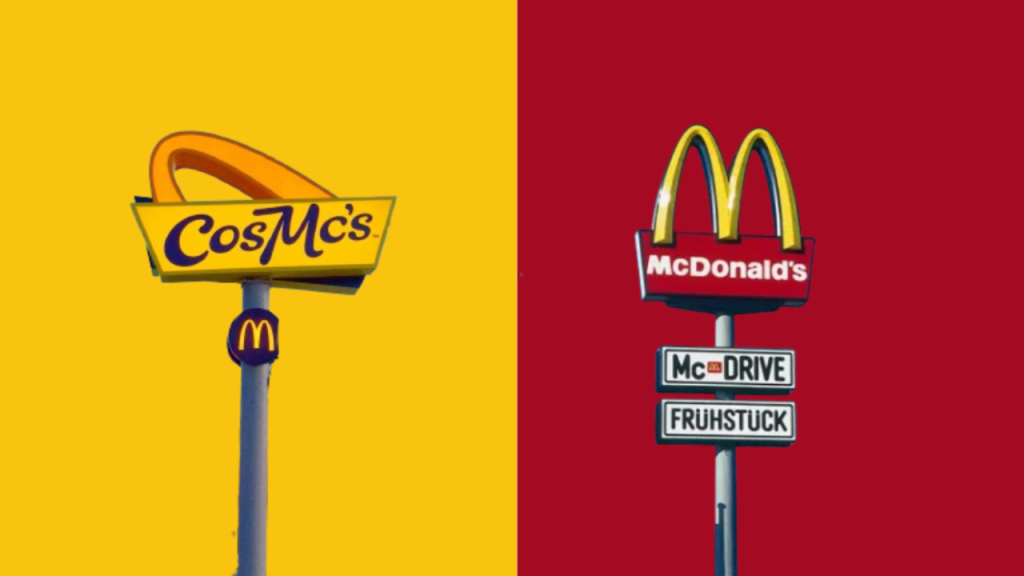
CosMc’s vs McDonald’s Performance: Economic Forces Behind the Strategic Closure
The announcement in May 2025 that McDonald’s would close all standalone CosMc’s locations by late June sent shockwaves through the restaurant industry and Wall Street analysts. Despite generating impressive foot traffic numbers that often exceeded traditional McDonald’s locations by 100-150%, the CosMc’s vs McDonald’s performance comparison ultimately revealed that CosMc’s succumbed to a combination of economic pressures, operational complexities, and shifting consumer spending patterns that made the standalone concept financially unsustainable.
McDonald’s reported its most challenging quarterly performance since the COVID-19 pandemic lockdowns, with same-store sales declining 3.6% in the first quarter of 2025—the steepest drop since 2020. This decline affected the broader McDonald’s system, with comparable restaurant sales falling across all major markets including the United States, International Operated Markets, and International Developmental Licensed Markets segments. The company’s stock price dropped 8% following the earnings announcement, reflecting investor concerns about consumer spending patterns and competitive pressures. This CosMc’s vs McDonald’s financial analysis showed how economic headwinds affected both brands differently.
Economic headwinds significantly impacted consumer behavior patterns that had initially supported CosMc’s success. Inflation rates averaging 4.2% throughout 2024 and early 2025 forced middle and lower-income households to reduce discretionary spending, particularly on premium beverages and specialty food items. Market research conducted by McDonald’s corporate analytics team revealed that 43% of CosMc’s target demographic had reduced spending on specialty coffee and beverages by 25% or more during the first quarter of 2025.
The operational costs associated with maintaining CosMc’s as a separate brand proved more substantial than initially projected. Each CosMc’s location required specialized equipment valued at approximately $180,000 per store, compared to $85,000 for traditional McDonald’s beverage stations. Additionally, the complexity of CosMc’s customizable menu required extended employee training programs lasting 40 hours per new hire, compared to McDonald’s standard 20-hour training protocol. These factors contributed to labor costs that averaged 28% of revenue at CosMc’s locations versus 22% at traditional McDonald’s restaurants. The CosMc’s vs McDonald’s operational cost analysis revealed significant structural challenges.
Supply chain complexities further complicated CosMc’s operations. The unique ingredients required for signature beverages, including specialty syrups, premium coffee beans, and exotic flavor enhancers, required separate distribution networks and vendor relationships. McDonald’s logistics team estimated that CosMc’s-specific inventory management added $2.4 million annually in additional supply chain costs across all locations. The specialized ingredients also created inventory turnover challenges, with 15% higher waste rates compared to McDonald’s traditional beverage ingredients.
Competitive pressures intensified throughout CosMc’s operational period. Starbucks responded to CosMc’s launch by introducing their own customizable beverage platform and expanding their food offerings, while Dunkin’ Donuts accelerated their digital innovation initiatives and loyalty program enhancements. These competitive responses, combined with the entrance of new players like Blue Bottle Coffee and Dutch Bros Coffee, created an increasingly crowded specialty beverage market that made customer acquisition more expensive and retention more challenging. The CosMc’s vs McDonald’s competitive landscape analysis showed how established players could rapidly counter new entrants. For more on how fast food brands are evolving, see our in-depth guide to fast food innovation.
CosMc’s vs McDonald’s Integration: The Future of Beverage Innovation Strategy
Rather than abandoning the CosMc’s experiment entirely, McDonald’s announced a comprehensive strategy to integrate successful CosMc’s-inspired beverages into hundreds of traditional McDonald’s locations beginning in late June 2025. This CosMc’s vs McDonald’s integration strategy represents one of the most significant menu innovations in McDonald’s recent history and demonstrates the company’s commitment to competing aggressively in the high-margin specialty beverage market despite the challenges faced by the standalone CosMc’s concept.
The integration strategy involves establishing dedicated beverage innovation teams at McDonald’s corporate headquarters and regional offices, representing an investment of approximately $15 million in specialized personnel and equipment. These teams will oversee the rollout of CosMc’s-inspired drinks across an initial test market of 500 McDonald’s locations throughout major metropolitan areas including Los Angeles, Chicago, New York, Dallas, and Atlanta. The phased approach allows McDonald’s to assess consumer response and operational feasibility before committing to system-wide implementation across their 13,515 United States locations.
McDonald’s market research indicated that specific CosMc’s beverages demonstrated consistent popularity across demographic segments, making them ideal candidates for integration into traditional McDonald’s menus. The Vanilla Matcha Galaxy Latte showed particular promise, with 78% of surveyed customers expressing interest in purchasing the beverage at McDonald’s locations. Similarly, the Churro Shaken Espresso and Tropical Spiceade demonstrated strong appeal among McDonald’s core customer base while attracting new customers seeking premium beverage options. This CosMc’s vs McDonald’s menu integration analysis guided the selection process.
The technological infrastructure required for beverage integration represents a significant capital investment. McDonald’s plans to install advanced espresso machines and flavor injection systems at participating locations, with equipment costs estimated at $45,000 per restaurant. However, this investment is substantially lower than the $180,000 per-location cost associated with full CosMc’s installations, making the integration approach more financially viable while maintaining most of the beverage quality and customization capabilities that made CosMc’s popular.
Training programs for McDonald’s employees will incorporate elements of the specialized CosMc’s curriculum, focusing on beverage preparation techniques, flavor balancing, and customer interaction skills necessary for premium beverage service. The company estimates that implementing CosMc’s-inspired beverage training will add 8 hours to standard employee onboarding programs but projects that the enhanced skills will contribute to improved customer satisfaction scores and higher average transaction values.
McDonald’s financial projections suggest that successful integration of CosMc’s beverages could increase average transaction values by 15-20% at participating locations. With beverage margins typically exceeding 75%, compared to 20-25% margins on traditional food items, the CosMc’s vs McDonald’s integration strategy could significantly impact McDonald’s profitability if successfully implemented. Industry analysts project that beverage integration could contribute an additional $2.8 billion in annual revenue if rolled out system-wide and achieve market penetration rates similar to McDonald’s McCafé expansion in the mid-2000s.
CosMc’s vs McDonald’s Industry Impact: How Competition Reshaped the Restaurant Market
The CosMc’s vs McDonald’s experiment has fundamentally altered competitive dynamics within the fast food and specialty beverage industries, forcing established players to reconsider their innovation strategies and market positioning. The willingness of McDonald’s, with its $23 billion annual revenue and conservative operational philosophy, to launch such an experimental concept sent clear signals throughout the restaurant industry about the importance of bold innovation.

What are your thoughts on this?